 .
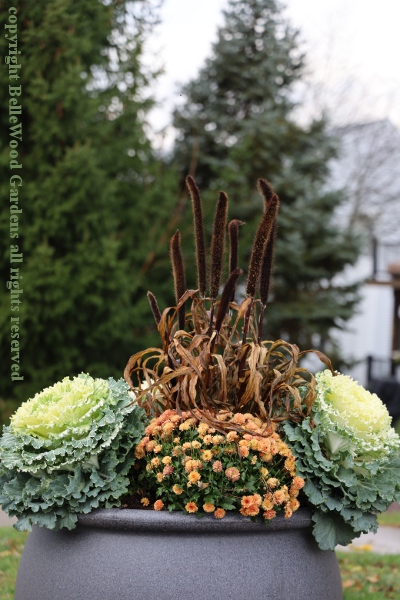
The community's public planters feature black ornamental millet, supersize kale. And chrysanthemums.
.
All content included on this site such as text, graphics and images is protected by U.S and international copyright law.
The compilation of all content on this site is the exclusive property of the site copyright holder.
Kiku at the New York Botanical Garden
Tuesday, 10 November 2026
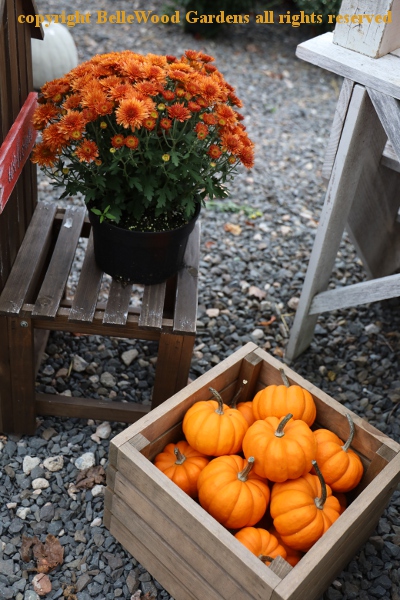
As summer ends and segues into early autumn, pots of chrysanthemums are thrust in front of us at grocery stores and big box stores alike. Public or private, they are disposable, to be treated as annuals and discarded when their flowers fade.
.
The community's public planters feature black ornamental millet, supersize kale. And chrysanthemums.
Off to the New York Botanical Garden for the media preview for the holiday train show.
At the Garden's entrance, near the Pine Tree cafe, there are multiple yellow chrysanthemums
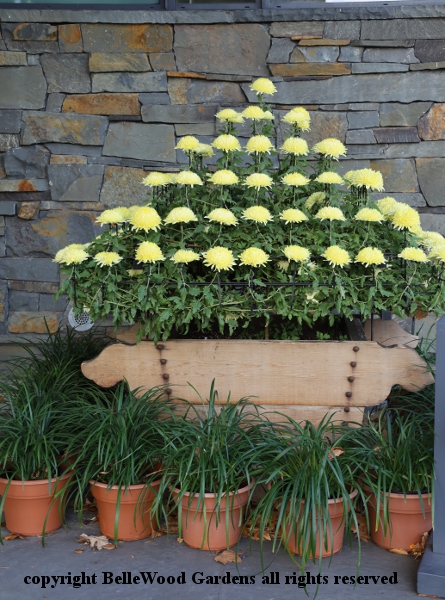 and a notice about kiku at the Nolen Greenhouses.
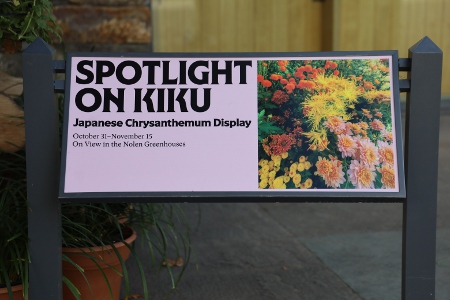
We took the tram and got off at the Nolen Greenhouses.
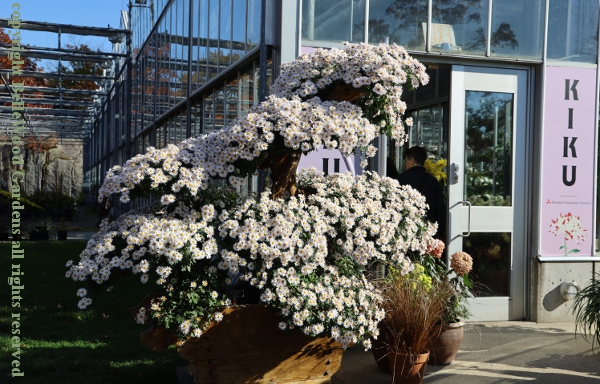
It looks like a chrysanthemum tree with billowing branches of flowers on a leafless trunk.
There are chrysanthemums with their petals precisely, superbly arranged.
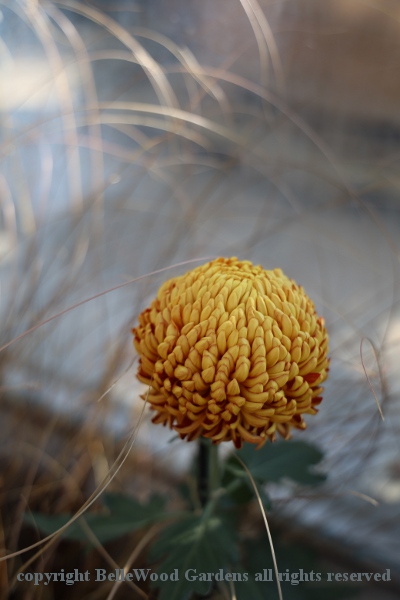
In fact that is how this is named, it is a regular incurve kiku.
There are individual chrysanthemums with ginormous flowers, one each.
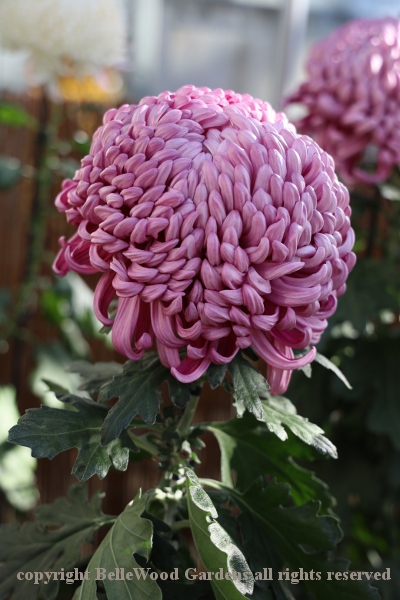
Supersize. Heavy. Individually staked lest their stem should snap from the weight.
copyright Wm P Woodall, all rights reserved
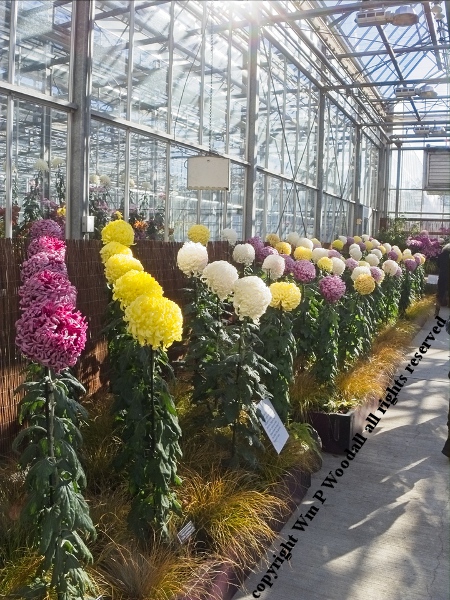
Pink ones. Yellow. White. Neatly arranged in rows. These are ogiku
The colors of rose pink, white, and yellow, are those traditionally used in the bridle reins, tazuna-ue, of the emperor's horse. Each small cutting is staked and pinched, extraneous growth removed so just one strong stem remains. Only the best, most perfect, strongest bud at the top of the stem is allowed to remain and mature to produce the showiest, largest possible flower.
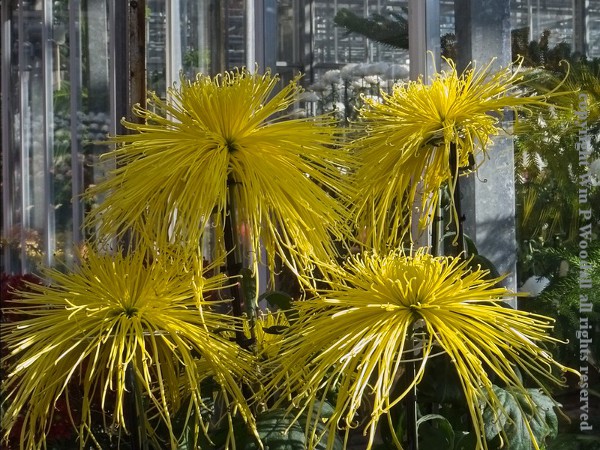
Elegant. Fanciful. Chrysanthemums such as we never see. There are
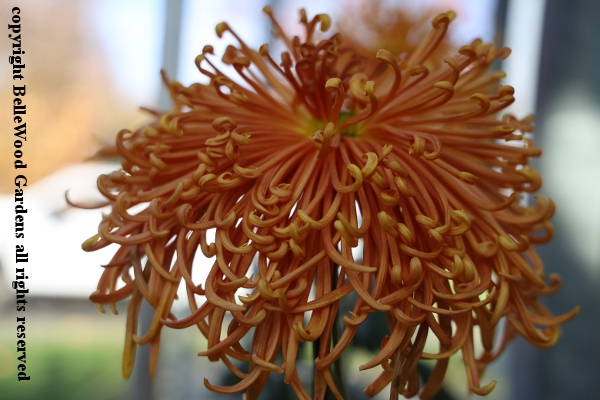
spider chrysanthemums, each flower with an explosion of thread-fine petals, some curled at their tips.
copyright Wm P Woodall, all rights reserved
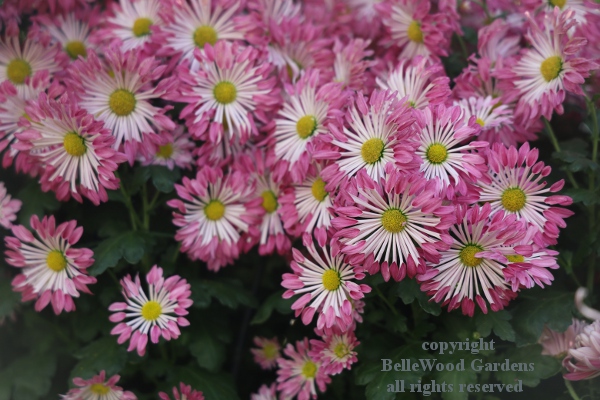
Perhaps you fancy a pink spoon kiku, each petal rolled until it unfurls as it reaches the end.
Small flowered chrysanthemums are chosen for kengai, cascade style.
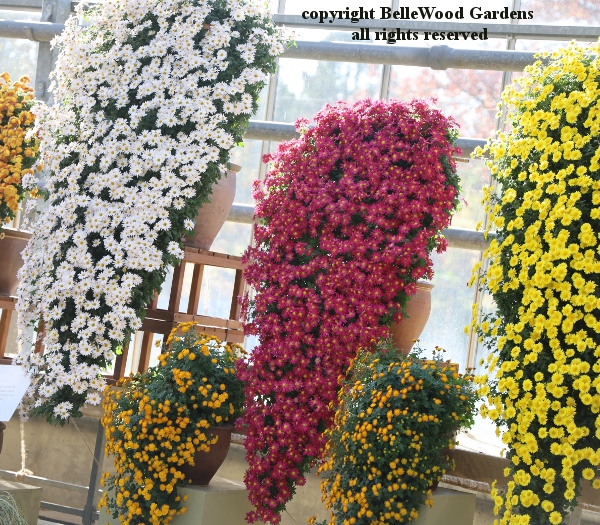
A single plant, supported by the framework on which it lays, angled when in bloom.
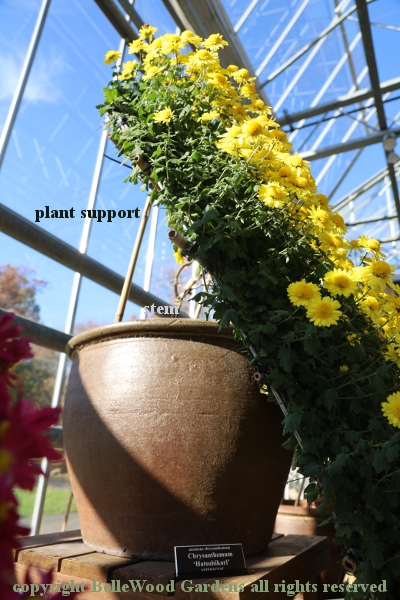
The stem is actually wrapped, especially where it branches
to prevent splitting. A rod supports the framework at the rear.
The chrysanthemums we saw at the Garden's entrance is singular, not multiples. Ozukuri
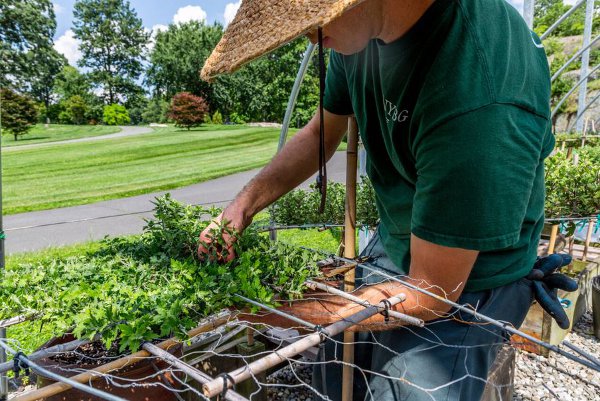
are patiently trained, month after month. An individual plant is encouraged to form branches
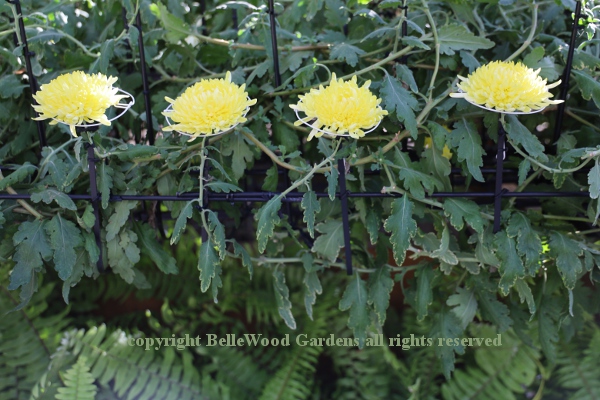
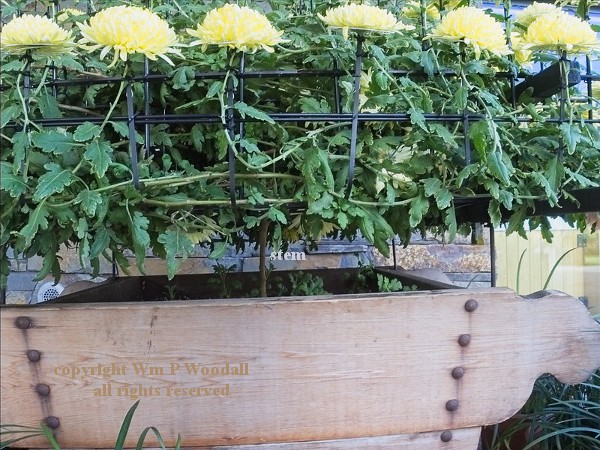
supported on a framework. As they grow a sturdy supporting framework creates the geometric array
copyright Wm P Woodall all rights reserved
of flowers, multiple flowers all arising on a single plant. See the only, the individual plant's stem?
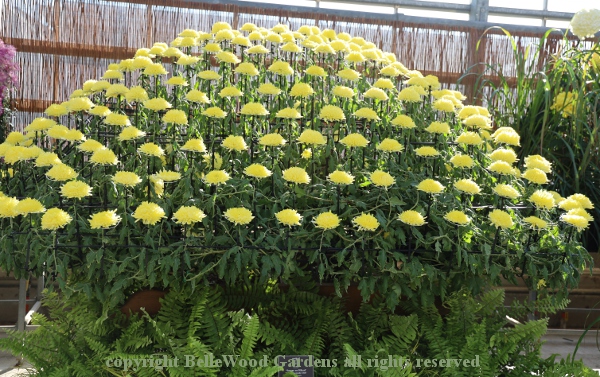
"Thousand blossom style" A study in geometry. Fantastic!
A single small cutting is allowed to produce five strong branches on the single main stem, then they in turn will produce many, many secondary branches. Each branch will be trained to grow very tall, supported on upright stakes. Now the fun begins, as a team of skilled gardeners loosen each branch from its support and weave it back and forth within a strong metal scaffolding. This fills the interior with green leaves, creating a sense of mass and solidity. Then branches are again coaxed upright and tied to vertical supports. Extraneous buds are mostly removed (a few are left as reserves, in case of accidents.) As each flower begins to open, an openwork wire collar is placed under each one, for additional support. Perhaps not a thousand blooms but certainly several hundred. And all on a single plant.
Eleven months of training. Two weeks of display. Take a month off. Then begin this labor of love all over again. It must be love, to root cuttings, watch over their growth. Water, feed, pinch, support. And share the results with Kiku in the Nolen Greenhouses at the New York Botanical Garden. Until next year . . .
If you have any comments or questions, you can e-mail me: jgglatt@gmail.com
Back to November
Back to the main Diary Page